Form 5471 and the Statute of Limitations Under Section 6501(c)(8)
By US-UK Tax Advisors cross-border tax team · Last updated AUG 13, 2026
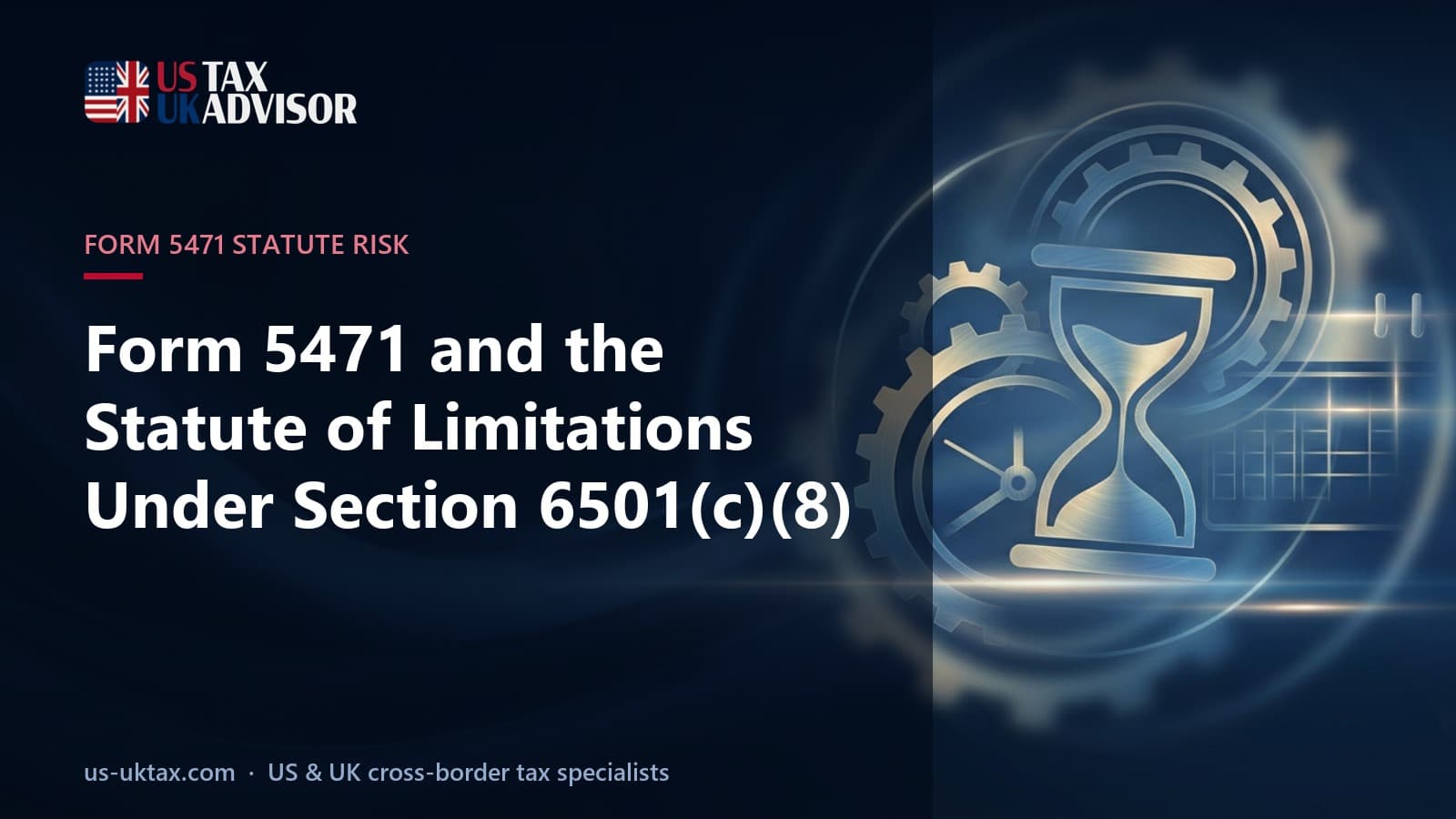
A missed Form 5471 does more than trigger penalties: section 6501(c)(8) can hold the IRS assessment window open on your entire return, year after year.
Key Takeaways
- Covers cross-border tax for US-UK cross-border taxpayers
- Applies to US persons with UK ties and UK residents with US income
- Highlights the filing, reporting and tax-treaty points to check
- Get personalised advice before acting on your own facts
Form 5471 is the information return that quietly decides how long the IRS can come back at you, because under Internal Revenue Code section 6501(c)(8) a missed one keeps the assessment window open on the whole return, not merely on the foreign corporation you failed to report. Section 6501(a) gives the IRS three years from the date a return is filed to assess tax. Section 6501(c)(8) displaces that outcome for any return to which required section 6038 information relates: the time for assessment shall not expire before the date which is three years after the date on which the Secretary is furnished the information required to be reported. If that information is never furnished, the three years never begin. A 2015 tax year with an unfiled Form 5471 is as open in 2026 as it was the week it was filed, and it will still be open in 2036.
What Is the Form 5471 Statute of Limitations Under Section 6501(c)(8)?
The Form 5471 statute of limitations is the period during which the IRS may assess tax on the income tax return to which a required Form 5471 relates. It is not a separate deadline that applies only to the information return. Section 6501(c)(8)(A) provides that where information is required to be reported under an election under section 1295(b), or under section 1298(f), 6038, 6038A, 6038B, 6038D, 6046 or 6046A, among other provisions, the time for assessment of any tax imposed by this title with respect to any tax return, event, or period to which such information relates shall not expire before the date which is three years after the date on which the Secretary is furnished the information required to be reported under such section.
Form 5471 is the vehicle by which a US person discharges the section 6038 reporting obligation for a foreign corporation, and the section 6046 obligation for organisations, reorganisations and acquisitions of stock. That is why a single unfiled Form 5471 reaches so far. The provision does not ask whether tax was due, whether the foreign corporation was profitable, or whether the omission was material. It asks only whether the required information was furnished.
Two phrases in the statute carry most of the weight. Furnished makes the period event-driven rather than calendar-driven: it starts when the IRS actually receives the information, not when the form was originally due. Shall not expire before establishes a floor rather than a substitute period. Section 6501(c)(8) can only lengthen the assessment window. It can never shorten one that is already longer under some other provision, a point that matters greatly once you look at the six-year rules further down.
How Long Does the IRS Normally Have to Assess Tax?
The default is short and well known. Under section 6501(a) the amount of any tax imposed by the Code is assessed within three years after the return was filed. A return filed before its due date is generally treated as filed on the due date, so an early filer gains nothing. For a US citizen living in the United Kingdom filing a Form 1040 for 2022 by the extended October deadline in 2023, the ordinary window would close in late 2026. That is the expectation most people carry, and it is the expectation section 6501(c)(8) destroys.
Before reaching the international rules, it is worth setting out the statutory extensions that sit alongside the three-year default, because a Form 5471 problem rarely arrives alone:
- Six years under section 6501(e)(1)(A)(i) where the taxpayer omits from gross income an amount in excess of 25 percent of the gross income stated in the return.
- Six years under section 6501(e)(1)(A)(ii) where the omitted income is attributable to an asset that must be reported under section 6038D, the section behind Form 8938, and the omitted amount exceeds $5,000.
- Six years under section 6501(e)(1)(C) where the taxpayer omits from gross income an amount properly includible under section 951(a), which is where subpart F inclusions from a controlled foreign corporation live.
- No time limit at all under section 6501(c)(1) for a false or fraudulent return filed with intent to evade tax, or under section 6501(c)(3) where no return was filed.
- An open-ended suspension under section 6501(c)(8) until the required international information is furnished, followed by three further years.
Only the last of these is triggered by the act of not filing a form. The others depend on what was left off the income side of the return. That distinction is the reason so many otherwise compliant filers are exposed: they reported their income correctly, paid the tax, and simply never attached a form they did not know existed.
How Does Section 6501(c)(8) Displace the Ordinary Period?
It works year by year and return by return. For each tax year in which a Form 5471 was required and not furnished, the assessment period for that year's income tax return does not begin. Filing the Form 1040 on time is irrelevant. Paying the correct amount of tax is irrelevant. The suspension attaches to the return to which the missing information relates, and it persists until the information arrives at the IRS.
Hold two or three foreign corporations and the effect compounds in an unhelpful direction. A single missed Form 5471 for one company is enough to hold the whole of that year open. It does not matter that the other Forms 5471 for the same year were filed correctly. The statutory test is whether the information required to be reported has been furnished, and a partial answer is not the information required to be reported.
It is worth separating the statute consequence from the penalty consequence, because they behave differently. The Form 5471 instructions confirm a $10,000 penalty for each annual accounting period of each foreign corporation for failure to furnish the information required by section 6038(a) within the time prescribed, with a further $10,000 for each 30-day period or fraction of a period once the failure continues 90 days after the IRS mails a notice, and that additional penalty is limited to a maximum of $50,000 for each failure. Section 6038(c) separately reduces the foreign taxes available for credit under sections 901 and 960 by 10 percent, with a further 5 percent for each three-month period after the 90-day period expires, subject to the limitation in section 6038(c)(2). The instructions also note that criminal penalties under sections 7203, 7206 and 7207 may apply. Those are finite, quantifiable exposures. The section 6501(c)(8) exposure is not quantifiable at all, because it has no end date.
Does the Suspension Cover the Whole Return or Only the Foreign Items?
By default it covers the whole return. The statutory language reaches any tax imposed by this title with respect to any tax return, event, or period to which such information relates. Read plainly, an unfiled Form 5471 for 2020 leaves the entire 2020 Form 1040 available for adjustment: the UK employment income, the share disposal, the rental profit from a London flat, the foreign tax credit computation, everything. None of it needs any connection to the foreign corporation.
Section 6501(c)(8)(B) is the limitation that changes this, and it is the single most valuable provision in the whole area. Where the failure to provide the required information is due to reasonable cause and not willful neglect, the extended assessment period applies only to the item or items related to such failure. The suspension survives, but its scope collapses from the entire return down to the items connected to the missed information return.
Three points of precision matter here. First, the carve-out narrows scope, not duration. Even where reasonable cause is established, the related items remain open indefinitely until the information is furnished. Second, reasonable cause is not automatic and is not assumed in the taxpayer's favour. The IRS notes in its Internal Revenue Manual at IRM 8.11.5 that section 6038 does not define reasonable cause, directing examiners instead to the general reasonable cause discussion at IRM 20.1.1.3.2 and to 26 CFR 301.6651-1(c), and pointing to the exception at 26 CFR 1.6038-2(k)(3)(ii) where the filer has substantially complied with its section 6038 reporting requirements. Third, the same reasonable cause narrative that supports penalty relief is doing double duty here, which is why it should be assembled with the statute consequence in mind and not only the penalty.
How Does the Clock Restart When Form 5471 Is Finally Furnished?
The restart is mechanical. Three years run from the date the Secretary is furnished the information required to be reported. Furnish a complete Form 5471 for 2019 in October 2026, and the assessment period for the 2019 return runs to roughly October 2029 rather than having closed years earlier. That is a real cost, but it is a cost with an end date, which is the entire point.
Completeness is where catch-up filings are most often weakened. The statutory trigger is not the act of filing something called a Form 5471; it is the furnishing of the information required to be reported. On a plain reading of that language, a Form 5471 lodged without the schedules the filer category actually requires is a poor trigger, and a practitioner should not assume that a thin form has started a three-year clock. The IRS has not published a bright-line statement on this point, so it should be treated as a drafting discipline rather than a settled rule: prepare the form to the standard you would want to defend, with every schedule the category demands, and the argument does not arise.
Mechanically, the IRS Delinquent International Information Return Submission Procedures page, live on IRS.gov and last reviewed in April 2026, directs that delinquent international information returns be attached to an amended income tax return and filed according to the instructions for that amended return, and that a reasonable cause statement may be attached to each return for which reasonable cause is asserted. The same page is candid that penalties may be assessed in accordance with existing procedures. It is a filing channel, not an amnesty.
Worked Example: Six Back Years for a US Founder of a UK Company
Consider a US citizen who has lived in London since 2018 and incorporated a UK limited company in 2019, holding 100 percent of the shares and serving as sole director. He is a Category 4 and Category 5 filer for every year the company has existed. His Form 1040 was prepared each year by a UK accountant who handled the UK position competently and never asked about the company for US purposes. Six Forms 5471, for 2019 through 2024, were never filed. Corporation tax was paid in full in the UK and his US returns showed the correct income and, in most years, no US tax due after credits.
In 2026 he assumes 2019 through 2022 are closed under the ordinary three-year rule. They are not. Under section 6501(c)(8) the assessment period for each of those six returns has never started. The consequence is not theoretical: it reaches a 2020 disposal of a listed shareholding and a 2021 sale of a UK buy-to-let, neither of which has anything to do with the company, because the suspension attaches to the return rather than to the item.
He remediates in late 2026 by furnishing complete Forms 5471 for all six years with amended returns. From that date each of the six years is open for a further three years, to roughly late 2029, after which they close. If reasonable cause is established under section 6501(c)(8)(B), the open scope in the meantime is confined to the items related to the missed Forms 5471, and the 2020 share sale and 2021 property disposal fall outside it. If reasonable cause is not established, the whole of each of the six returns stays available for adjustment for those three years. Either way, compare that with the counterfactual: had he done nothing, all six years would have remained permanently open, 2025 and 2026 would have joined them, and the exposure would have grown by one further open year every April thereafter.
Why a Catch-Up Filing Beats Doing Nothing
The strategic asymmetry is stark and it is the reason a quiet catch-up filing is a materially different decision from silence. Doing nothing preserves an exposure with no terminal date and adds a year to it annually. Filing converts an open-ended exposure into a dated one and puts a foreseeable end on the file. Nothing else available to the taxpayer achieves that, because the only thing that starts the clock is furnishing the information.
- It starts the three-year period under section 6501(c)(8), which is the only mechanism that ever closes these years.
- It caps continuation penalty exposure, because the additional section 6038(b) charge only begins to run 90 days after the IRS mails a notice of the failure, and a voluntary filing pre-empts that notice.
- It preserves the reasonable cause position under section 6501(c)(8)(B), which is far harder to advance once the IRS has raised the issue first.
- It protects eligibility for the IRS submission routes, which are closed to taxpayers already under civil examination or criminal investigation or already contacted about the delinquent returns.
- It fixes the record while the evidence still exists, including UK statutory accounts, Companies House filings, corporation tax computations and board minutes that become progressively harder to reconstruct.
How Does This Interact With the Streamlined Foreign Offshore Procedures?
The Streamlined Foreign Offshore Procedures remain live on IRS.gov and were reviewed by the IRS during 2026. For a US citizen or lawful permanent resident, the non-residency requirement is met where, in at least one of the three most recent years for which the due date has passed, the individual did not have a US abode and was physically outside the United States for at least 330 full days. The submission comprises three years of delinquent or amended returns with all required information returns, six years of FBARs, a signed Form 14653 certifying that the failures resulted from non-willful conduct, and full payment of tax and interest. Eligible filers are not subject to failure-to-file and failure-to-pay penalties, accuracy-related penalties, information return penalties or FBAR penalties.
Here is the point that the penalty-focused commentary tends to miss. Streamlined is scoped to three years of returns. It is an excellent answer to the penalty question and it does nothing at all for years outside that window, because those years' section 6038 information is not furnished by the submission. A founder with eight back years of missed Forms 5471 who files a compliant streamlined package has closed the penalty question and started the section 6501(c)(8) clock on three years, leaving five earlier years suspended indefinitely. Whether to reach further back is a judgement call that has to be made deliberately, with the statute consequence understood, rather than defaulted into.
The delinquent international information return route is the alternative where income was reported correctly and tax was paid, which is the common pattern for UK company owners whose UK corporation tax and credits left no US liability. That route has no year cap, so it can be used to furnish information for years that streamlined would not reach. Note also a currency point that catches people out: the IRS withdrew its published Delinquent FBAR Submission Procedures page during 2026, so an FBAR delinquency is no longer addressed by a standalone published IRS procedure and should not be described as though it were.
What Farhy and the Later Appeal Decisions Actually Decided
This case law is routinely misdescribed, so it is worth stating precisely. In 2023 the US Tax Court held in Farhy v. Commissioner that the IRS lacked statutory authority to assess and administratively collect the penalty imposed by section 6038(b) for a failure to file Form 5471. On 3 May 2024 the Court of Appeals for the District of Columbia Circuit reversed, holding that the IRS does have that authority and reinstating the penalties. In 2026 the Second Circuit reached the same conclusion in Safdieh, reversing the Tax Court. No Supreme Court decision has resolved the question, and the appellate direction of travel favours the IRS.
What that litigation decided is the IRS's assessment authority for the Form 5471 penalty. It decided nothing whatever about section 6501 and the period for assessing tax. Even during the window when the Tax Court's position stood unreversed, section 6501(c)(8) operated exactly as written and every affected year stayed open. Anyone treating the penalty litigation as a reason to sit on unfiled Forms 5471 has confused two entirely separate statutory regimes, and has taken the risk that runs forever in exchange for temporary comfort on the risk that is capped.
Two Traps That Survive a Perfect Form 5471 Catch-Up
The first trap is that section 6501(e) runs in parallel and is not switched off by furnishing the form. Where a controlled foreign corporation generated subpart F income that was omitted from gross income, section 6501(e)(1)(C) independently gives the IRS six years from the date the return was filed to assess. Where the omitted income was attributable to an asset reportable under section 6038D and exceeded $5,000, section 6501(e)(1)(A)(ii) does the same. Because section 6501(c)(8) provides only that the period shall not expire before three years after the information is furnished, it is a floor: it cannot cut a six-year period short. In practice the correct model is the longest of the applicable periods for each year, not the (c)(8) date alone, and a UK company that has been generating subpart F or global intangible low-taxed income inclusions is exactly the profile where this bites.
The second trap is that the UK side does not move in sympathy. HMRC's assessment time limits run from the end of the UK tax year on their own schedule: broadly four years where reasonable care was taken, six years where the loss of tax was brought about carelessly and twenty years where it was deliberate, with an extended twelve-year limit for offshore matters in non-deliberate cases, as set out on GOV.UK. Nothing a US person does or fails to do with a Form 5471 suspends or extends HMRC's window, and nothing about a settled UK year narrows the IRS's. A UK company owner can therefore hold a completely closed UK position for 2018 and a permanently open US position for the same period. That asymmetry has a practical sting: reopening old US years often requires evidencing UK tax paid to support foreign tax credit claims for years the UK regards as long finished, and the section 6038(c) credit reduction can be applied to precisely those credits.
How to Close a Form 5471 Statute of Limitations Exposure
- Map every foreign corporation against every year of ownership, including dormant companies, loss-making years and years in which no US tax was due, since none of those facts affects the section 6038 obligation.
- Establish the filer category separately for each year, because category changes as ownership, officer and director status change, and the required schedules change with it.
- Prepare each Form 5471 complete to its category, on the basis that the statutory trigger is the furnishing of the information required to be reported rather than the lodging of a form.
- Choose the route deliberately: streamlined foreign offshore where the taxpayer is non-willful and meets the non-residency requirement, or the delinquent international information return route where income and tax were correctly reported, recognising that only the second reaches beyond three years.
- Build the reasonable cause record contemporaneously and in writing, because section 6501(c)(8)(B) is the only thing standing between an open foreign item and an open entire return.
- Diarise two dates for every year: the three-year date measured from furnishing, and the six-year date under section 6501(e) where subpart F or section 6038D assets are in play.
For US citizens and green card holders running UK companies, holding UK investment portfolios or working in banking on both sides of the Atlantic, this is the reason a missed Form 5471 deserves attention out of all proportion to its apparent size. The penalty is finite. The open assessment period is not, and it is the one consequence that gets worse purely through the passage of time. Our US and UK tax preparation and compliance work for founders, investors and investment bankers is built around closing exactly these files: reconstructing the back years, preparing complete Forms 5471 to their proper category, documenting reasonable cause to the standard section 6501(c)(8)(B) requires, and putting an end date on a liability that otherwise has none.
Related reading and tools
- US Tax Services & IRS Compliance
- UK Tax Services
- IRS Streamlined Filing
- UK Income Tax Calculator
- US Federal Income Tax Calculator
Every situation is different. Book a cross-border tax consultation to discuss how these rules apply to you.
Authoritative sources
IRS — Streamlined Filing Compliance Procedures
FinCEN — Report of Foreign Bank and Financial Accounts (FBAR)
GOV.UK — Tax on foreign income
IRS — Foreign Earned Income Exclusion