IRS Form 14653 Streamlined Filing Guide
By US-UK Tax Advisors cross-border tax team · Last updated AUG 20, 2026
The one form that decides your whole filing You can prepare three years of perfect returns and six years of flawless FBARs, and still have the IRS rej...
Key Takeaways
- Covers irs form 14653 streamlined filing guide for US-UK cross-border taxpayers
- Applies to US persons with UK ties and UK residents with US income
- Highlights the filing, reporting and tax-treaty points to check
- Get personalised advice before acting on your own facts
The one form that decides your whole filing
You can prepare three years of perfect returns and six years of flawless FBARs, and still have the IRS reject your streamlined submission. The reason almost always comes down to a single document. The IRS form 14653 streamlined filing UK certification is the legal heart of the whole package, and a weak one undoes everything else you got right. It is the form that tells the IRS, under penalty of perjury, why you fell behind — and whether it believes you.
This guide is written for US citizens, dual nationals, and accidental Americans in the UK who are using the Streamlined Foreign Offshore Procedures and need to get this certification right. By the end, you will understand exactly what the IRS form 14653 streamlined filing UK form is, what it must contain, how to write the non-willful narrative properly, and the mistakes that turn a strong case into a rejected one. The returns and FBARs are mechanical, but this form calls for judgment — so it deserves more care than any other part of your filing.
What Is IRS Form 14653 Streamlined Filing UK?
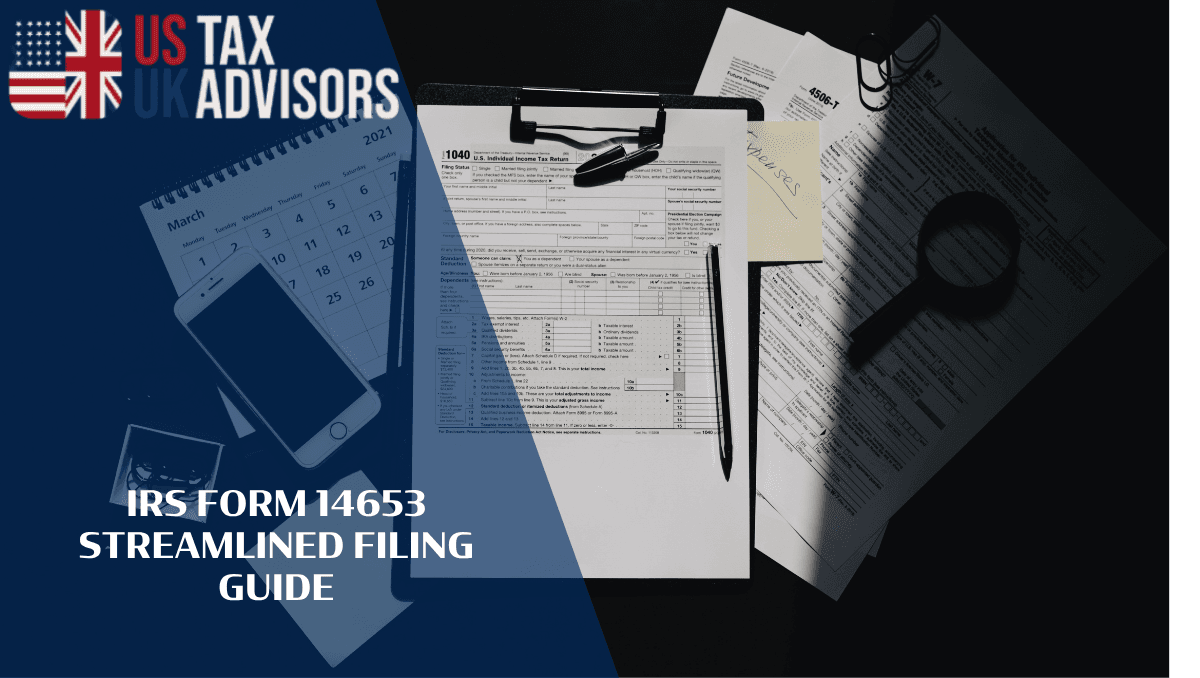
Form 14653 is the "Certification by U.S. Person Residing Outside of the United States for Streamlined Foreign Offshore Procedures." In plain terms, the IRS form 14653 streamlined filing UK document is the signed statement that accompanies your back returns and FBARs when you use the foreign streamlined track. The official form and instructions sit at .
The form does three jobs at once. It confirms you are eligible for the foreign track by meeting the non-residency test. It certifies that your failure to file was non-willful — a genuine mistake rather than deliberate evasion. And it commits you to having filed all required returns and FBARs for the covered years.
That middle job is the hard one. You must explain, in your own words, the specific facts behind your failure to comply. This narrative is not a tick-box exercise; it is the part the IRS reads most closely, and it carries the legal weight of the entire submission.
Why Form 14653 Matters More Than Ever in 2026
Two pressures make this certification especially important right now. First, the IRS has grown more willing to scrutinise non-willful claims. A vague or boilerplate narrative no longer slips through as easily as it once did, and the agency can request more information or reject a filing it finds unconvincing. The streamlined programme rules confirming this stricter posture are published at .
Second, the data backing up your story is more visible than ever. Under FATCA, UK banks report US-linked accounts straight to the IRS, so a narrative that conflicts with the account history the IRS already holds is a serious problem. The reporting rules driving that exposure live at .
Third, the IRS form 14653 streamlined filing UK certification is signed under penalty of perjury. A false statement here is far more serious than a simple filing error, which is exactly why it rewards careful, honest drafting rather than a rushed few lines.
What Form 14653 Must Actually Contain
The eligibility and residency confirmation
The form opens by confirming you qualify for the foreign track. You certify that you meet the non-residency test — broadly, that you lived outside the United States for at least 330 full days in one or more of the three covered years. UK-resident Americans usually satisfy this easily, but the dates must be accurate, because this single statement determines whether you belong on the penalty-free foreign track at all.
The non-willful certification statement
This is the core of the IRS form 14653 streamlined filing UK document. You must state that your failure to report income, pay tax, and file FBARs resulted from non-willful conduct. The IRS defines this as conduct due to negligence, inadvertence, mistake, or a good-faith misunderstanding of the law. The distinction between willful and non-willful behaviour, including FBAR context, is explained at .
The personal facts narrative
Here you tell your story. The IRS expects specific facts, not generalities, and a strong narrative typically covers:
- Your background — where you were born, your citizenship history, and when you moved to the UK.
- Why you did not file — the genuine reason, such as never knowing the US taxes worldwide income.
- How you learned of the obligation — for example, a FATCA letter from your UK bank.
- What you did once you knew — showing you acted promptly to put things right.
- Your reliance on others — any UK accountant or adviser who never mentioned US obligations.
The more honest and specific this account, the stronger the filing. A narrative that reads as evasive, or that contradicts your account history, is the fastest route to rejection.
Step-by-Step: How to Complete Form 14653 Properly
Confirm your eligibility first. Run the non-residency day count for each covered year before writing anything. If you do not meet the 330-day test, you need Form 14654 for the domestic track instead, so this check decides which form you even use.
Gather your supporting facts. Pull together your travel history, citizenship background, account opening dates, and any FATCA correspondence. The narrative must rest on verifiable facts, so assemble them before you draft.
Draft the narrative in plain English. Write your story clearly and specifically. Avoid legalistic hedging, but never overstate. The IRS guidance on the foreign track at sets the standard your account should meet.
Reconcile the story with your numbers. Make sure your narrative matches the returns and FBARs in the package. If you claim you forgot about an account, yet it shows large active transfers, the inconsistency will be noticed. Align the words with the figures.
Sign under penalty of perjury — carefully. Once satisfied, sign and date the form. This signature is a sworn statement, so treat it with the seriousness it carries rather than as a final formality.
Keep a copy and your evidence. Retain the signed form and the documents behind your narrative. If the IRS asks questions later, a clear contemporaneous record strengthens your position considerably.
Real-World Example: Form 14653 in Practice
Consider Rachel, a US-UK dual citizen born in Boston who moved to Edinburgh at age seven and built her entire adult life in Scotland. She received a FATCA letter from her bank at 41 and discovered, to her shock, that she had owed US tax returns for decades. She had a salary, a workplace pension, and a cash ISA.
Her first instinct was to write a brief, panicked certification saying only that she "didn't know." Her adviser stopped her. A thin narrative like that, on the IRS form 14653 streamlined filing UK form, invites exactly the scrutiny she wanted to avoid. Instead, they built a specific account: she left the US as a child, never held a US passport in adulthood, always filed and paid UK tax through PAYE, and genuinely believed her UK compliance was the whole story. The FATCA letter was the first time anyone mentioned US obligations.
That detailed, honest narrative — backed by her travel and citizenship history — sailed through. The returns used foreign tax credits to erase her US liability, and the certification did its job. Rachel's case shows the difference between a certification that merely asserts non-willfulness and one that demonstrates it.
Common Mistakes People Make with Form 14653
Writing a vague, one-line narrative. Many filers state only that they "were not aware" and leave it there. The IRS wants specific facts, and a thin story signals either carelessness or something to hide.
Contradicting the financial record. A narrative that clashes with account histories the IRS already holds via FATCA is a serious red flag. Always reconcile your words with your numbers before signing.
Overstating innocence. Some applicants exaggerate their ignorance to the point of implausibility. Honesty is more persuasive than a polished but unbelievable account, so resist the urge to gild the story.
Using the wrong form. Form 14653 is for the foreign track only. Filers who fail the residency test need Form 14654 instead, a distinction confirmed in the IRS streamlined procedures guidance at .
Treating willful conduct as non-willful. If you knew about the obligation and ignored it, certifying non-willfulness is a false statement under perjury. When your facts are borderline, take advice before signing rather than after.
Forgetting to cover every required year. The certification must confirm you filed all required returns and FBARs for the covered period. Missing a year leaves the package incomplete and the certification inaccurate.
How US-UK Tax Can Help You with Form 14653
The IRS form 14653 streamlined filing UK certification is where cross-border experience matters most, because it turns on judgment rather than arithmetic. US-UK Tax works only in this niche, and our advisers hold the credentials that count on both sides of the Atlantic — Enrolled Agent (EA) status with the IRS alongside UK qualifications including ACA, ACCA, CTA, and ATT. That dual coverage means we understand both the technical filing and the human story behind it.
We help you build a narrative that is specific, honest, and consistent with your financial record, then prepare the returns and FBARs that sit alongside it. Crucially, we assess your willfulness candidly first, because we will not put our name near a certification that does not hold up. Where your facts are genuinely non-willful, we make sure the form demonstrates it rather than merely claiming it.
If you need to get this certification right, get in touch with our team today at or call 0333-8807974 to talk through your situation in confidence.
Conclusion
Three points are worth keeping. The IRS form 14653 streamlined filing UK certification is the legal core of a foreign streamlined filing, and a weak narrative can sink an otherwise perfect package. It must contain specific, honest facts that explain your non-willful conduct and reconcile with your financial record. And because it is signed under penalty of perjury, it deserves more care than any other part of the submission.
If you are a US expat, dual citizen, or accidental American in the UK preparing a streamlined filing, the narrative on this form is where your effort matters most. Contact US-UK Tax at hello@us-uktax.com or on 0333-8807974 or on 0333-8807974 to make sure your certification stands up.
FAQs
Q: What is IRS Form 14653 used for? Form 14653 is the certification you submit with the Streamlined Foreign Offshore Procedures. It confirms you meet the non-residency test, certifies that your failure to file was non-willful, and states that you have filed all required returns and FBARs for the covered years. The form's non-willful narrative is the part the IRS scrutinises most closely.
Q: What should the non-willful narrative on Form 14653 say? It should give specific, honest facts explaining why you failed to comply. Strong narratives cover your background, why you did not file, how you learned of the obligation, and what you did once you knew. The IRS wants genuine detail, not vague statements like "I was not aware," so specificity and consistency with your records are essential.
Q: Is Form 14653 the same as Form 14654? No. Form 14653 is for the Streamlined Foreign Offshore Procedures, used by those who meet the non-residency test and pay no penalty. Form 14654 is for the domestic track, used by those who fail the residency test and pay a 5% penalty. Filing the wrong form for your situation can derail the entire submission.
Q: Is Form 14653 signed under penalty of perjury? Yes. The certification is a sworn statement, which makes accuracy critical. A false claim of non-willful conduct is far more serious than an ordinary filing error and can expose you to significant consequences. This is why you should assess your willfulness honestly, ideally with a specialist, before signing the form.
Q: What happens if my Form 14653 narrative is too vague? A thin or boilerplate narrative is one of the most common reasons the IRS questions or rejects a streamlined filing. It can prompt requests for more information or undermine your non-willful claim entirely. Providing specific facts that reconcile with your account history is the safest way to avoid this outcome.
Q: Can I amend Form 14653 if I make a mistake? Correcting a streamlined certification after submission is difficult and far from guaranteed, because the filing is treated as a one-time disclosure. This is precisely why getting the form right the first time matters so much. Reviewing your narrative and reconciling it with your numbers before signing is far safer than trying to fix errors afterwards.
Authoritative sources
IRS — Streamlined Filing Compliance Procedures
FinCEN — Report of Foreign Bank and Financial Accounts (FBAR)
GOV.UK — Tax on foreign income
IRS — Foreign Earned Income Exclusion