Staying Compliant After Streamlined Filing
By US-UK Tax Advisors cross-border tax team · Last updated AUG 20, 2026
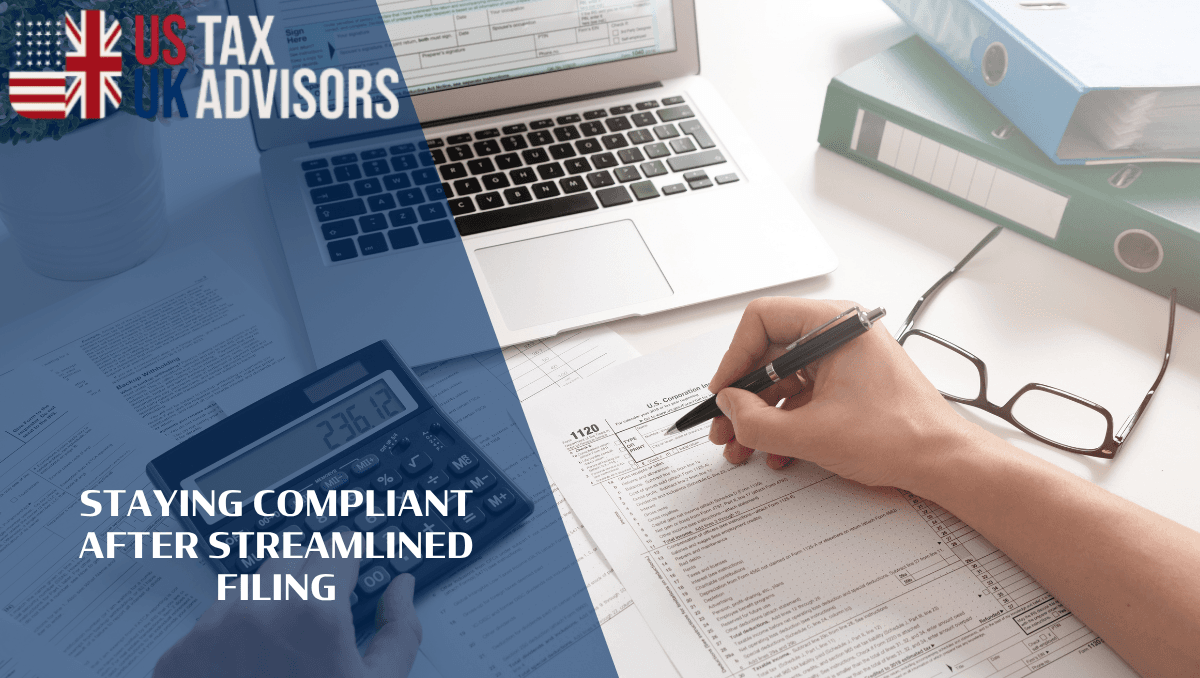
What comes next once your back taxes are sorted You came forward, filed your back returns, certified non-willful conduct, and finally feel free of the...
Key Takeaways
- Covers staying compliant after streamlined filingv for US-UK cross-border taxpayers
- Applies to US persons with UK ties and UK residents with US income
- Highlights the filing, reporting and tax-treaty points to check
- Get personalised advice before acting on your own facts
What comes next once your back taxes are sorted
You came forward, filed your back returns, certified non-willful conduct, and finally feel free of the IRS. So here is the uncomfortable truth: the hardest part is not getting clean — it is staying clean. Managing after streamlined filing compliance UK is where many US expats stumble, because they treat the streamlined programme as a finish line rather than a starting point. Miss a single year, and you can undo all the work and expense that brought you back into the system.
This guide is written for US citizens, dual nationals, and accidental Americans in the UK who have completed the Streamlined Filing Compliance Procedures and now need to stay compliant for good. By the end, you will know exactly what you must file each year, the deadlines that apply, the habits that keep you safe, and the mistakes that quietly drag people back into non-compliance. Coming forward once was the brave move. Building a simple annual routine is what protects it — and that routine is far easier than the catch-up you have already survived.
What Is After Streamlined Filing Compliance UK?
The term after streamlined filing compliance UK describes the ongoing obligations a US expat must meet once they have completed the streamlined programme and returned to good standing with the IRS. It is not a separate procedure — it is simply normal, current-year US tax compliance, carried out properly every year from now on.
In practice, that means filing a US federal tax return annually, reporting your worldwide income, and submitting an FBAR whenever your foreign accounts cross the threshold. The streamlined programme only fixed your past; it created no shield for the future. The IRS expects you to file on time going forward, exactly like any other citizen, and the rules for Americans abroad are set out at .
Who does this affect? Every US person living in the UK, regardless of whether they owe any US tax. Filing is triggered by income level, not by a balance due — so even expats whose UK tax wipes out their US liability through credits must still file.
Why After Streamlined Filing Compliance UK Matters More Than Ever in 2026
Three reasons make ongoing compliance sharper this year. First, the IRS has no formal "second streamlined." If you go quiet again after using the programme, you cannot simply re-enter it for the new gap years. A repeat lapse looks far less innocent, and your earlier non-willful certification makes a second claim of ignorance hard to sustain.
Second, FATCA reporting keeps tightening. UK banks continue to report US-linked accounts to the IRS each year, and the automatic exchange of information between HMRC and the IRS means a missed filing surfaces quickly. The UK's own framework for international tax cooperation is described at .
Third, the penalties for slipping remain steep. A single missed FBAR can trigger a penalty exceeding $10,000, even when no tax is owed. For someone who just spent time and money getting clean, maintaining after streamlined filing compliance UK is the cheapest insurance available — a few hours of admin a year against four- and five-figure penalties.
Your Ongoing US Filing Obligations as a UK Resident
The annual federal tax return
Every year, you must file a US federal return reporting worldwide income — UK salary, self-employment, rental income, dividends, and interest included. Most expats use one of two tools to eliminate the US bill: the Foreign Earned Income Exclusion or the Foreign Tax Credit. The exclusion rules are explained at . Maintaining after streamlined filing compliance UK means choosing the right tool each year and applying it consistently, since switching carelessly between them can cause problems.
The FBAR and Form 8938
Two separate foreign-account reports catch people out. The FBAR (FinCEN Form 114) is required when your combined foreign accounts exceed $10,000 at any point in the year. Form 8938 is a separate FATCA report with higher thresholds, filed with your tax return. They overlap but are not the same, and you may need both. Crucially, the $10,000 FBAR trigger is aggregate across every account, not per account.
UK-specific traps to keep reporting
ISAs, stocks-and-shares accounts, and certain UK pensions all remain reportable to the IRS, even though HMRC treats some of them as tax-free. Many expats assume that once streamlined is done, these wrappers stop mattering. They do not. Each year they must be reported again, and ISAs in particular often create US tax on income the UK ignores entirely.
Step-by-Step: Building a Compliant Annual Routine
Set your two key dates now. Americans abroad get an automatic filing extension to 15 June, with the standard 15 April deadline still setting when interest starts. The FBAR is due 15 April with an automatic extension to 15 October. Put all of these in your calendar permanently.
Gather documents as the year runs. Keep a running folder of UK pay slips, P60s, bank interest certificates, dividend vouchers, and year-end account balances. Reconstructing figures was the painful part of streamlined; never let it build up again.
Track your highest account balances. Because the FBAR uses peak balances, note the highest point each account reaches during the year. The official filing portal sits at , and accurate figures keep the report clean.
Choose your relief method deliberately. Decide each year whether the Foreign Earned Income Exclusion or the Foreign Tax Credit serves you better, especially if your income or UK tax changes. The credit often wins for higher earners paying substantial UK tax.
File both the return and the FBAR. Treat them as a pair. Filing the return but forgetting the FBAR is one of the most common ways expats break compliance without realising it.
Review life changes annually. Marriage, a new child, a property purchase, a pension transfer, or starting a business all change your US position. The IRS guidance on filing thresholds is at .
Real-World Example: After Streamlined Filing Compliance UK in Practice
Consider Priya, a dual US-UK citizen in Edinburgh who completed the streamlined programme two years ago after discovering her filing obligation. Relieved it was over, she assumed she only needed to act again if she ever owed US tax. The following year she changed jobs, opened a new savings account for a house deposit, and forgot it existed at tax time.
When she came to us for her annual filing, we spotted that her combined balances had briefly topped $18,000 mid-year because the deposit and her current account overlapped. She had already mentally filed herself as "sorted." Maintaining after streamlined filing compliance UK meant we filed her FBAR reporting the peak balance, prepared her return using the Foreign Tax Credit to keep her US bill at zero, and set her up with a simple year-round balance log.
The outcome: no penalty, full compliance, and a repeatable system. Priya now spends roughly an hour gathering documents each year, and her filings run smoothly — a world away from the stress of her original catch-up.
Common Mistakes People Make After Streamlined Filing
Assuming "no tax owed" means "no filing needed." Filing is triggered by income, not by a balance due. Plenty of expats owe nothing thanks to credits yet still must file a return and an FBAR every year. Skipping it because nothing is payable is a frequent and costly error.
Forgetting the FBAR after filing the return. People remember the tax return and overlook the separate foreign-account report. Because the FBAR goes to FinCEN, not with your return, it slips minds easily — and each miss can cost over $10,000.
Misjudging the $10,000 threshold. The trigger is the combined peak of all accounts, not each account alone. New accounts, house deposits, or a temporary inheritance can push you over without you noticing.
Ignoring ISAs and pensions again. Expats often believe streamlined "dealt with" these. Every year they remain reportable, and ISAs can generate US tax even when the UK charges none.
Switching relief methods carelessly. Jumping between the Foreign Earned Income Exclusion and Foreign Tax Credit without understanding the consequences can trigger problems, including a five-year lock-out after revoking the exclusion.
Missing the deadlines. The automatic June extension lulls people into thinking there is no urgency, yet interest can still run from April. The deadline rules for Americans abroad are confirmed at .
How US-UK Tax Can Help You Stay Compliant
Staying clean after the streamlined programme is far simpler than the catch-up, but it still rewards specialist support — and that is exactly the work US-UK Tax does every day. Our advisers hold the credentials that matter on both sides of the Atlantic, including Enrolled Agent (EA) status with the IRS alongside UK qualifications such as ACA, ACCA, CTA, and ATT. That dual coverage means your annual return, your FBAR, and your treatment of UK pensions and ISAs are all handled by people who understand both systems at once.
We manage after streamlined filing compliance UK as a calm annual routine: tracking your account balances, choosing the right relief method each year, filing your return and FBAR together, and flagging the life changes that shift your US position. Our goal is to make ongoing compliance feel like a quick yearly checkup rather than a recurring scramble.
If you have completed streamlined filing and want to stay protected for good, get in touch with our team today at or call 0333-8807974 to set up a straightforward annual filing plan.
Conclusion
Three points are worth holding onto. The streamlined programme fixes your past but creates no protection for the future, so v means filing a US return and, where required, an FBAR every single year from now on. Filing is triggered by income, not by tax owed — many expats owe nothing yet must still file. And because a second lapse is far harder to fix than the first, a simple annual routine is the cheapest protection you have.
If you are a US expat, dual citizen, or accidental American in the UK who has already come forward, the smart move is to lock in a yearly system now. Contact US-UK Tax at or on 0333-8807974 to keep your hard-won compliance intact.
FAQs
Q: Do I still have to file US taxes every year after streamlined filing? Yes. The streamlined programme only corrects past years; it creates no ongoing exemption. You must file a US federal return every year you meet the income threshold, reporting worldwide income, plus an FBAR whenever your foreign accounts exceed the limit. Filing is required even when credits reduce your actual US tax to zero.
Q: What happens if I miss a year after completing streamlined filing? A repeat lapse is serious. You generally cannot re-enter the streamlined programme for new gap years, and your earlier non-willful certification makes a fresh claim of innocence hard to sustain. Missed FBARs alone can trigger penalties above $10,000 per year, so it is far safer to file late immediately and seek advice than to leave a new gap.
Q: Do I need to file an FBAR every year as a UK resident? You must file an FBAR for any year your combined foreign accounts exceed $10,000 at any point, measured across all accounts together. For most working expats in the UK, this threshold is crossed routinely, so an annual FBAR becomes normal. It is filed separately from your tax return, through FinCEN, and missing it is a common compliance slip.
Q: I owe no US tax because of UK credits — do I still file? Yes, absolutely. US filing obligations depend on your income level, not on whether tax is due. The Foreign Tax Credit and Foreign Earned Income Exclusion often reduce your US bill to nil, but you must still file the return to claim them. Owing nothing does not remove the requirement to file.
Q: Are my ISA and UK pension still reportable after streamlined filing? Yes. UK tax wrappers carry no weight with the IRS, so ISAs, stocks-and-shares accounts, and many pensions remain reportable every year. ISAs in particular can even generate US tax on income the UK treats as tax-free. Completing streamlined did not change how these accounts are reported going forward.
Q: How can I keep my US tax compliance simple each year? Build a light routine: diarise the key deadlines, keep a running folder of income documents, and log the highest balance each foreign account reaches during the year. Decide your relief method deliberately and file your return and FBAR together. Many expats use a specialist adviser for an annual checkup, turning a once-stressful task into a short yearly process.
Authoritative sources
IRS — Streamlined Filing Compliance Procedures
FinCEN — Report of Foreign Bank and Financial Accounts (FBAR)
GOV.UK — Tax on foreign income
IRS — Foreign Earned Income Exclusion