
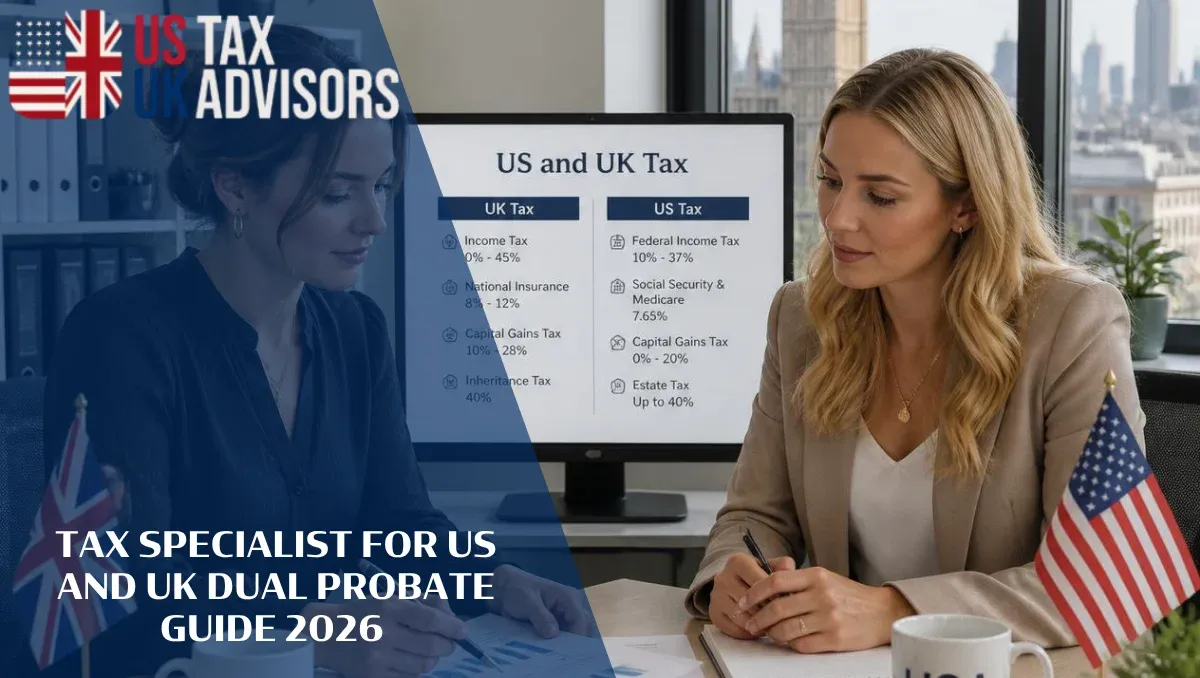
Tax Specialist for US and UK Dual Probate Guide 2026 |
By US-UK Tax Advisors cross-border tax team · Last updated AUG 20, 2026
Tax Specialist for US and UK Dual Probate Guide 2026 | Tax Specialist for US and UK: Dual Probate Guide 2026 Tax Specialist for the US and UK on Dual ...
Key Takeaways
- Covers cross-border planning for US-UK cross-border taxpayers
- Applies to US persons with UK ties and UK residents with US income
- Highlights the filing, reporting and tax-treaty points to check
- Get personalised advice before acting on your own facts
Tax Specialist for US and UK Dual Probate Guide 2026 |
Tax Specialist for US and UK: Dual Probate Guide 2026
Tax Specialist for the US and UK on Dual Probate
The estate of a US citizen who dies as a UK resident typically requires two separate probate or estate administration processes to run in parallel — one in England and Wales or Scotland under the domestic court's jurisdiction, and one in the United States through the IRS estate tax filing regime and, where the deceased held US assets, through an ancillary probate proceeding in the relevant US state. Furthermore, every tax specialist for US and UK who advises on cross-border estate administration finds that the two processes are managed by different professionals in each country, with a UK probate solicitor handling the grant of representation and HMRC IHT400, and a separate US adviser managing Form 706 and the IRS estate tax — and that the coordination between those two processes, specifically the calculation of the US-UK estate tax treaty credit, is consistently the weakest link in the entire administration.
This article is written for executors, personal representatives, and beneficiaries of estates involving a deceased who was a US citizen or US green card holder and who died as a UK resident with assets in both jurisdictions. By the end of this guide, you will understand how the two probate processes interact, what a dedicated tax specialist for the US and the UK does to manage them cohesively, and the most costly mistakes that arise when the two administrations operate in silos.
What Is a Tax Specialist for the US and UK?
A tax specialist for the US and the UK is a cross-border tax professional qualified in both US federal tax and UK tax, specifically able to manage interactions between the two systems for a deceased US citizen's estate. Furthermore, in the dual probate context, this role goes beyond tax preparation — the specialist must understand how the UK grant of representation is obtained, how the HMRC IHT400 and IHT421 work, and how those UK proceedings generate the data needed to calculate the US-UK estate tax treaty credit on Form 706. Specifically, the most practically important function of a tax specialist for the US and the UK in a dual probate is to ensure that the UK IHT assessment and the US Form 706 estate tax are calculated using the same asset values, the same date-of-death exchange rates, and the same situs allocation — since any inconsistency between the two returns produces an incorrect treaty credit that either underpays or overpays US estate tax.
The UK probate process guidance is at https://www.gov.uk/wills-probate-inheritance. The IRS Form 706 filing requirements are at https://www.irs.gov/forms-pubs/about-form-706.
Why Dual Probate Planning Matters More in 2026
The Post-Sunset US Estate Tax Threshold Catches More Estates
The anticipated reduction in the US unified credit from $13.61 million to approximately $7 million per person after 31 December 2025 will bring substantially more UK-resident US citizen estates into the Form 706 filing regime from 2026. Furthermore, a UK-resident US citizen with a modest UK property, a pension, and modest savings could previously die without any US estate tax filing obligation — with a worldwide estate below the $13.61 million threshold — but from 2026 the same estate may require a full Form 706, treaty credit calculation, and potentially US estate tax payment for the first time. Consequently, executors and solicitors who assumed that estates of this size had no US dimension in prior years must apply the post-sunset analysis before concluding that no Form 706 is required for estates settled in 2026 and beyond.
The UK Court's Acceptance of Foreign Wills
UK-resident US citizens with assets in both jurisdictions frequently hold a single US will rather than separate UK and US wills. Furthermore, the UK Probate Registry will accept a foreign will — including a US will — as the basis for a UK grant of probate, provided the will meets certain formal validity requirements under UK law. Still, the process for obtaining a UK grant based on a US will is more complex and time-consuming than for a standard UK will. Consequently, executors named in a US will who need to administer UK assets must understand the UK re-sealing or fresh-grant process before they can access UK bank accounts, release UK shareholdings, or transfer UK real estate. The UK government guidance on probate when the deceased had a foreign will is at https://www.gov.uk/wills-probate-inheritance. Additionally, https://www.icaew.com provides technical guidance for practitioners on the interaction between UK probate and foreign estate administrations.
The Ancillary Probate Requirement for US Situs Assets
Where the deceased held US situs assets — US real estate, US brokerage accounts, US retirement accounts subject to probate, or interests in US companies — the UK grant of probate does not automatically authorize the executor to deal with those US assets. Furthermore, each US state has its own rules for recognizing foreign grants of representation and for requiring a separate ancillary probate proceeding in that state before US assets can be transferred. Consequently, an executor who holds a UK grant of probate for an estate that includes a Florida condominium or a New York investment account must obtain either a re-sealing of the UK grant in the relevant US state or a separate ancillary probate appointment before those assets can be accessed. According to https://www.aicpa.org, dual probate proceedings involving both UK and US assets are among the most complex estate administrations handled by international private client practitioners, with coordinating the timing of the two processes being a significant practical challenge.
How UK and US Probate Processes Interact
The UK Probate Process for US Citizen Decedents
In England and Wales, the executor named in the deceased's will must apply for a grant of probate from the Probate Registry before they can legally deal with most UK assets. Furthermore, before applying for the grant, the executor must value the entire UK estate, prepare the HMRC IHT400 inheritance tax account reporting all UK assets and any worldwide assets subject to UK IHT — including assets that qualify for relief such as BPR and APR — and obtain an IHT reference number from HMRC. Additionally, where UK IHT is payable, the executor must pay at least the IHT due on non-installment assets before the Probate Registry will issue the grant, creating a timing constraint that can delay the entire administration if the estate is illiquid. The HMRC IHT400 and IHT205 guidance is at https://www.gov.uk/valuing-estate-of-someone-who-died.
The Form 706 Timeline and Its Conflict with UK Probate
Form 706 is due nine months after the date of death, with a six-month extension available by filing Form 4768. Furthermore, the UK IHT400 typically takes three to six months to complete, HMRC then takes a further two to six months to issue the IHT clearance, and the UK probate can take twelve to eighteen months or more for complex estates. This timeline substantially exceeds the fifteen-month extended Form 706 deadline. Consequently, the executor of a combined US-UK estate faces a structural conflict between the US and UK timelines: the Form 706 must be filed before the UK administration is complete, meaning the treaty credit for UK IHT must be estimated or calculated on a preliminary basis, with a supplemental Form 706 filed once the final UK IHT is agreed. Additionally, the US estate tax estimated at the Form 706 filing date must be paid to avoid interest accruing at the IRS underpayment rate, even where the final treaty credit is not yet known.
The Treaty Credit Mechanism in Dual Probate
The US-UK Estate and Gift Tax Treaty provides a credit that prevents the same assets from being subject to both UK IHT and US estate tax at their combined rates. Furthermore, the credit is calculated on a proportional basis — each country's tax is reduced by a credit equal to the proportion of the total combined tax attributable to assets taxed in both jurisdictions — and the calculation requires the executor to know both the final UK IHT charge and the full US Form 706 estate tax simultaneously. Consequently, the treaty credit calculation is the single most important technical task in a dual probate, and getting it wrong — by using different asset values, different exchange rates, or different situs allocations on the UK and US returns — produces either an overstatement or an understatement of the credit that results in either overpaying US estate tax or a future IRS assessment. The treaty text and HMRC double taxation relief guidance are at https://www.gov.uk/government/publications/usa-tax-treaties.
Managing a Dual Probate: Practical Steps
Step 1 — Identify all assets in both jurisdictions and their US situs classification.
Within the first few weeks of the death, prepare a complete worldwide asset inventory covering every asset in both the UK and the United States — UK real estate, UK investment accounts, UK business interests, US retirement accounts, US real estate, US brokerage accounts, and any other property in either jurisdiction. Furthermore, classify each asset as UK situs, US situs, or jointly situated under the US-UK treaty situs rules — since the treaty credit calculation depends on the correct situs allocation of each asset. Additionally, confirm whether any US assets require ancillary probate in the relevant state, since those assets cannot be transferred until the ancillary proceeding is completed. The timing must be factored into the overall administration plan. The IRS guidance on US estate tax situs rules is at https://www.irs.gov/forms-pubs/about-form-706.
Step 2 — File Form 4768 within nine months of death.
File Form 4768 with the IRS within nine months of the date of death to obtain the automatic six-month extension of the Form 706 filing deadline, extending the deadline to fifteen months. Furthermore, estimate the US estate tax liability based on the preliminary asset values and pay the estimated tax with the Form 4768 to avoid interest accruing on unpaid estate tax from the nine-month original due date. Additionally, document the basis for the preliminary tax estimate in writing — including the exchange rates used, the asset values applied, and the estimated treaty credit — so that the supplemental Form 706 can reconcile the preliminary payment with the final tax liability when the UK IHT is agreed.
Step 3 — Prepare and file the UK IHT400 and obtain the grant of probate.
Prepare the HMRC IHT400 reporting all UK assets and any worldwide assets subject to UK IHT, applying any applicable reliefs — BPR, APR, the nil-rate band, the residence nil-rate band, and any transferable nil-rate band from a predeceased spouse. Furthermore, pay any UK IHT due on non-installment assets before applying for the grant of probate, and monitor the HMRC clearance timeline to establish when the final UK IHT charge is agreed. Additionally, record the sterling IHT charge for each asset category in the treaty credit format — since the treaty credit calculation requires the UK IHT to be expressed both in sterling and in US dollars at the date-of-death exchange rate — so that the cross-border specialist can use the HMRC-agreed figures directly in the final Form 706 supplemental filing.
Step 4 — Coordinate the ancillary probate in any relevant US state.
Identify every US situs asset that requires ancillary probate — including real estate in any US state, bank and brokerage accounts held at US financial institutions, and interests in US companies or trusts — and engage a US attorney in the relevant state to initiate the ancillary proceeding using the UK grant of probate as the basis. Furthermore, confirm whether the relevant US state will re-seal the UK grant or require a separate ancillary letters testamentary, as procedures vary by state and affect the timeline for releasing US assets. Additionally, confirm whether any US retirement accounts are subject to beneficiary designation rules rather than probate — IRA and 401(k) accounts pass directly to the named beneficiary without probate — and assess the income tax and required minimum distribution implications of those accounts separately from the probate assets.
Step 5 — File the final Form 706 with the treaty credit once UK IHT is agreed.
Once the HMRC IHT assessment is finalized and IHT clearance has been issued, prepare and file the final Form 706 — or a supplemental Form 706 if a preliminary return was filed earlier — incorporating the final treaty credit calculation. Furthermore, confirm that the asset values, exchange rates, and situs allocations used in the Form 706 are consistent with those used in the HMRC IHT400, and document any differences with a reconciliation note. Additionally, claim any additional treaty credit arising from the final UK IHT charge that was not included in the preliminary estimate, and file a claim for any overpaid US estate tax where the final treaty credit exceeds the preliminary estimate. The IRS supplemental Form 706 guidance is at https://www.irs.gov/forms-pubs/about-form-706.
Case Study: US Citizen in Leeds, Dual Probate Administration
Our team was engaged by the executor — a UK-national adult daughter — of a US citizen who had lived in Leeds for nineteen years and who died with a combined US-UK estate comprising a UK residential property (£560,000), a UK investment portfolio (£380,000), a US IRA (approximately $180,000 with the daughter named as beneficiary), and a Florida condominium held in the deceased's sole name (approximately $320,000). The deceased held a US will executed in Florida, naming the daughter as sole executor and beneficiary. No UK will exist. The daughter had no experience of US or UK estate administration.
After reviewing the estate, we identified the following immediate priorities. First, the UK probate required a foreign will application at the England and Wales Probate Registry — the Florida will needed to be formally notarised and apostilled before the UK registry would accept it, a process that took six weeks. Furthermore, the Florida condominium required a separate ancillary probate proceeding in Florida, since the UK grant would not be re-sealable in Florida — Florida requires a separate ancillary administration for foreign personal representatives. Additionally, the US IRA of $180,000 passed directly to the daughter as named beneficiary and was not subject to probate, but it was subject to US income tax as distributions were taken — a point the daughter was entirely unaware of.
We filed Form 4768 within nine months of death with a preliminary estimated estate tax payment of $28,000 — calculated on the worldwide gross estate of approximately $1.82 million (all UK assets converted at date-of-death rates plus the Florida condo) minus the anticipated treaty credit for UK IHT on the UK property and portfolio. Furthermore, the UK IHT was calculated at approximately £52,800 on the estate above the nil-rate band and residence nil-rate band, and the treaty credit, converted at the date-of-death exchange rate, reduced the US estate tax by approximately $19,400, resulting in a final US estate tax of approximately $9,200 after the credit. Additionally, the Florida ancillary probate was completed eight months after the UK grant was issued, allowing the condo to be sold with proceeds distributed to the daughter fourteen months after the date of death. The final Form 706 was filed with a refund claim for $18,800 — the difference between the preliminary payment and the final estate tax after the treaty credit.
Common Mistakes in Dual Probate Administrations
Mistake 1 — Not Identifying the US Estate Tax Obligation Early
The most common mistake is the UK probate solicitor completing the UK administration without ever identifying that a Form 706 obligation exists. Furthermore, the UK solicitor's engagement letter covers the UK grant, HMRC IHT400, and UK asset distribution — it does not include any review of US filing obligations, since that is outside the solicitor's training and regulatory scope. The correct approach requires the executor to engage a tax specialist for the US and the UK within the first few weeks after death to identify all US obligations — Form 706, final Form 1040, estate income tax, and ancillary probate requirements — before the UK administration is fully underway.
Mistake 2 — Using Different Values on the UK and US Returns
The treaty credit calculation only works correctly where both returns use the same date-of-death asset values expressed in consistent currencies. Furthermore, where the UK IHT400 uses one sterling value for the UK property and the Form 706 uses a different US dollar value derived from a separate appraisal, the treaty credit is calculated on an inconsistent basis, and the total combined tax does not equal the sum of the two returns' tax charges. The correct approach requires a single set of date-of-death valuations agreed by both the UK and US advisers, with a consistent exchange rate conversion applied to produce the sterling and US dollar values for each return.
Mistake 3 — Missing the Form 4768 Extension Deadline
The Form 706 is due nine months after the date of death — a deadline that UK-focused executors are typically unaware of, since UK probate has no equivalent fixed filing deadline. Furthermore, missing the Form 4768 extension filing means the automatic extension is unavailable, and the Form 706 is then subject to late-filing penalties from the nine-month original due date regardless of how complex the administration is. The correct approach is to engage a cross-border adviser within six months of the death, at the very latest, to ensure the extension is filed on time. The IRS Form 4768 instructions are at https://www.irs.gov/forms-pubs/about-form-4768.
Mistake 4 — Not Recognizing the Ancillary Probate Requirement
US assets — real estate, bank accounts, brokerage holdings — cannot generally be dealt with by a UK personal representative acting solely based on a UK grant of probate. Furthermore, each US state has its own ancillary probate requirements, and attempting to sell a US property or close a US account without the correct local authority can create legal complications that significantly delay the administration and expose the executor to personal liability. The correct approach requires identifying every US situs asset at the start of the administration and confirming the ancillary probate requirements with a US attorney in the relevant state before any action is taken on those assets.
Mistake 5 — Treating the US IRA as a Probate Asset
US individual retirement accounts pass directly to the named beneficiary by contract and are not subject to the probate or Form 706 estate tax process. However, the IRA's value is included in the gross estate for Form 706 reporting purposes. Furthermore, distributions from inherited IRAs are subject to US income tax in the year of distribution, and beneficiaries who are not US residents must comply with specific US withholding requirements when taking distributions. The correct approach requires a specific analysis of the IRA's tax treatment by a tax specialist in the US and the UK before any distributions are taken, to ensure that withholding and reporting are handled correctly.
Mistake 6 — Not Filing the Final Form 1040 for the Deceased
The executor has a legal obligation to file the final Form 1040 for the deceased covering 1 January of the year of death to the date of death, reporting all worldwide income for that period. Furthermore, many UK-focused executors engage a UK accountant for the deceased's UK self-assessment but leave the final Form 1040 unfiled because no one on the UK-focused team is aware of the obligation or equipped to prepare it. The correct approach requires the cross-border specialist to prepare the final Form 1040 alongside the Form 706, coordinating the income tax and estate tax positions for the year of death and claiming the foreign tax credit for any UK income tax paid on the same income. IRS guidance on filing for deceased taxpayers is at https://www.irs.gov/individuals/filing-the-final-return-for-a-deceased-person.
Get in Touch
At US-UK Tax, our team of Chartered Tax Advisers (CTA), Enrolled Agents (EA), and Certified Public Accountants (CPA) — members of the Chartered Institute of Taxation (CIOT) and the American Institute of CPAs (AICPA) — is the tax specialist for the US and the UK practice that executors and personal representatives of combined US-UK estates turn to when neither a UK probate solicitor nor a US estate attorney alone can cover the full scope of the administration. Furthermore, we manage the complete US side of the dual probate — Form 4768 extension, Form 706 preparation with the worldwide asset inventory, preliminary and final treaty credit calculations, final Form 1040 for the deceased, estate income tax on Form 1041, and ancillary probate coordination with US attorneys in the relevant states — working in structured information-sharing with the UK probate solicitor from the first week of the administration. We have managed dual probate administrations involving UK and US assets across multiple US states, and we understand the practical constraints of the UK probate timeline that affect when and how the US filings must be completed.
Contact our team today to begin a confidential review of your dual probate administration. Email hello@us-uktax.com, call 0333-8807974, or visit https://www.us-uktax.com/contact/ to book a consultation.
Conclusion
Probate across two jurisdictions is not simply two separate estate administrations running in parallel — it is one integrated process with a single set of asset values, a single exchange rate conversion, and a single treaty credit calculation that must be consistent across both the UK IHT400 and the US Form 706 to produce the correct combined tax outcome. Furthermore, the structural conflict between the UK probate timeline — which can take eighteen months or more for complex estates — and the fifteen-month extended Form 706 deadline means that executors must commit to the cross-border filing obligation early rather than waiting for the UK administration to reach a settled state. Consequently, engaging a tax specialist for the US and the UK at the point of death, rather than months into the UK administration, is the only way to manage the dual probate without creating timing, valuation, or treaty credit inconsistencies that would cost the estate additional tax and professional fees to correct.
The three most important actions for any executor of a combined US-UK estate are: first, engage a cross-border specialist within the first few weeks of death to assess the Form 706 obligation and file Form 4768 within nine months; second, prepare a single consistent set of date-of-death valuations shared between the UK IHT400 and Form 706 to ensure the treaty credit is calculated correctly; and third, identify every US situs asset requiring ancillary probate and engage a US attorney in the relevant state before taking any action on those assets. Contact US-UK Tax at hello@us-uktax.com or call 0333-8807974 to begin a confidential dual probate review today.
Contact Us
US-UK Tax | hello@us-uktax.com | 0333-8807974
FAQs
Q: Does a UK grant of probate allow dealing with US assets?
Not automatically. Each US state has its own rules for recognizing foreign grants. US real estate and bank accounts typically require ancillary probate proceedings in the relevant state before a UK personal representative can deal with those assets.
Q: What is the Form 706 deadline for a UK-resident US citizen's estate?
Form 706 is due nine months after death, extended to fifteen months by filing Form 4768 before the nine-month deadline. Any estimated estate tax must still be paid within nine months to avoid interest accruing on the unpaid balance.
Q: How does the US-UK treaty credit prevent double taxation in probate?
The treaty allocates taxing rights by asset situs and provides a proportional credit — each country's tax is reduced by the share attributable to assets taxed in both jurisdictions. Both returns must use consistent values and exchange rates for the credit to be correct.
Q: Can a US will be used for UK probate?
Yes. The UK Probate Registry accepts foreign wills provided they meet UK formal validity requirements. The will typically needs to be notarised and apostilled before the registry will accept it. The process takes longer than for a UK will.
Q: Are US IRAs subject to probate and US estate tax?
IRAs pass directly to named beneficiaries by contract and bypass probate. However, the IRA's value is included in the US gross estate for Form 706 purposes. Distributions are subject to US income tax, and non-resident beneficiaries face specific withholding requirements.
Q: Must the executor file a final US income tax return for the deceased?
Yes. The final Form 1040 covers the period from 1 January of the year of death through the date of death and reports all worldwide income. It is the executor's legal obligation, and it must be filed alongside Form 706, with a foreign tax credit claimed for UK income tax on the same income.
Authoritative sources
IRS — Streamlined Filing Compliance Procedures
FinCEN — Report of Foreign Bank and Financial Accounts (FBAR)
GOV.UK — Tax on foreign income
IRS — Foreign Earned Income Exclusion